
Nascita di una collezione
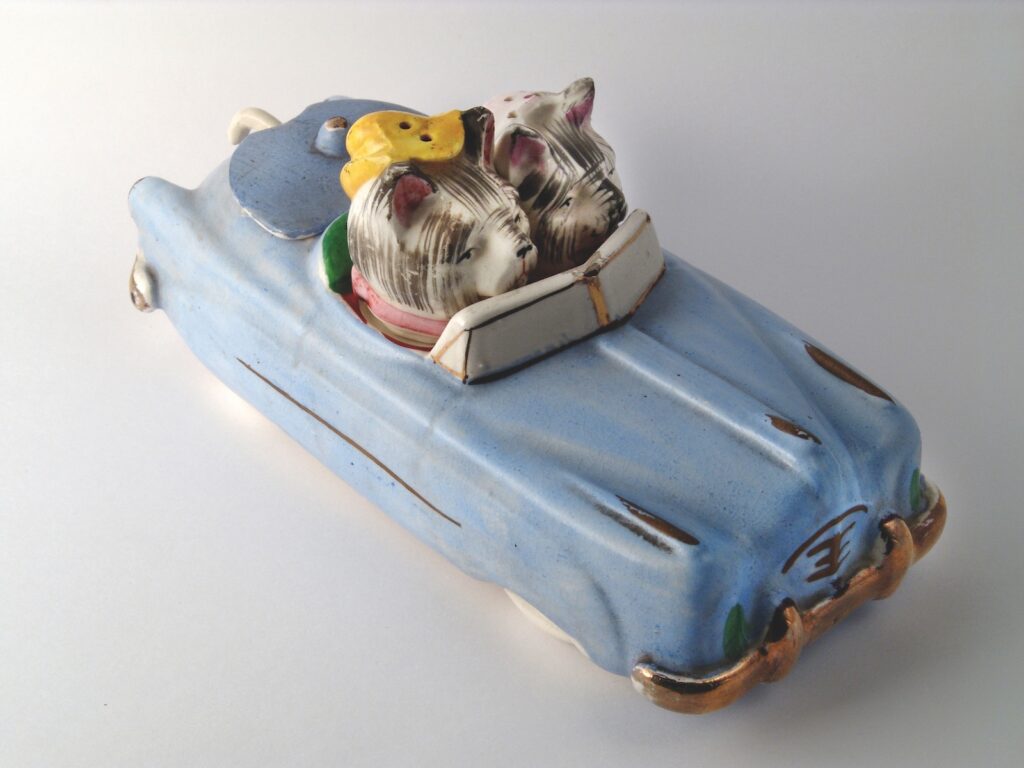
Nell’agosto del 1978 a Edimburgo in occasione del Festival delle Arti, curiosando fra i negozietti di antiques mi imbattei in un singolare oggetto, totalmente all’insegna del kitsch. Era una vettura di ceramica colorata, che al posto di guida presentava le teste di due cagnetti, entrambi estraibili, con dei buchini nella parte superiore e due tappi di sughero nella parte inferiore. In breve, si trattava di un “salino” e “pepino” completati in questo caso da un bagagliaio usato come senapiera. Sotto il piano dell’auto la sorprendente scritta Occupied Japan. Il mistero si infittiva e, detto fatto, decisi di acquistarlo. Qualche tempo dopo, sempre curiosando qua e là, a Portobello, in quegli anni di gran moda, ma anche nelle brocantes in Francia e in Italia, piuttosto che a New York al mitico Chelsea Market (oggi chiuso), scoprii che quel primo ingenuo oggetto aveva insospettabilmente molti compagni. Dalle mie ricerche si aprì così un mondo nuovo e divertente.
Conoscevo, per averle viste nei musei più importanti, le splendide saliere del passato, autentici capolavori, come quella d’oro e di smalti, raffigurante Poseidone e la Terra, che Francesco I Re di Francia, commissionò nel 1540 a Benvenuto Cellini e che oggi si può ammirare a Vienna. Ero abituata alle belle tavole italiane, dove nei pranzi eleganti comparivano importanti saliere d’argento o di vermeil, piuttosto che di cristallo con tappi di smalto prezioso. Ma non avevo mai visto salini e pepini in forma di frullatori, di giocatori di baseball o di dinosauri. Scoprii così che dai primi decenni del ‘900 gli Americani, evidentemente seguaci del principio “perché mai una cosa utile e necessaria non può essere anche divertente?”, avevano cominciato a produrre saliere e pepiere (salt & pepper shakers ) in forme divertenti, talora stupefacenti, inusuali per quella funzione. I materiali erano i più diversi, dalla bachelite alla ceramica, dalla porcellana allo stagno, al legno, al vetro e altri ancora.
Nascevano così, nel mito di Via col Vento, Aunt Jemima e Uncle Moses, dolci e sorridenti réclame dell’americana Quaker, celebre produttrice di fiocchi d’avena e di biscotti. Compaiono sulle tavole, come sale e pepe, gli strumenti di casa e di cucina dei felici Anni ’50 (“The Good Life“), dai frullatori alle padelle, dalla lavatrice e asciugatrice Westinghouse, ai cuochi della Louisiana o ai baffuti chef francesi, al tostapane, al ferro da stiro, alla macchina da cucire, al telefono a parete. Arrivano gli “States Shakers”, che ognuno dei 50 Stati americani presenta ai turisti come ricordo della visita: due pezzi in ceramica, uno in forma del territorio, l’altro del prodotto o del monumento che caratterizza il Paese. Ad esempio, quello dello Stato di Washington sul Pacifico, è simboleggiato da una bellissima mela, nella cui produzione questa regione eccelle. Sono disegnati da Parkcraft Co. (fondata nel 1949) e sono prodotti da Taneycomo Ceramics Factory (Hollister, Montana).
Ci sono anche i clowns, i cartoons, gli animali più diversi, le zucche e i fantasmi di Halloween, i treni e gli aerei e la lista è ancora lunghissima. La maggior parte di questi deliziosi oggetti nasce in realtà come advertising. Era l’ingenua pubblicità di una volta, oggetti da dare al posto di address o fiammiferi, in un ristorante o località balneare o per un evento (come il Trylon and Perisphere, simbolo della World Fair di New York del 1939). Diventano anche doni attrattivi, dentro a scatole di biscotti , di noccioline (come i celebri Mister Peanuts dell’omonima casa), di detersivi o di cibo per cani; sono oggetti utili alla famiglia e divertenti per i bambini, che spingono le mamme ad acquistarli. Tutti, ovviamente e rigorosamente, sono l’uno sale e l’altro pepe. Lo spargisale si riconosce perché di solito si presenta con un buchino e lo spargipepe con tre, ma possono anche essere due o tre per il sale e cinque per il pepe. Spesso gli stessi contenitori, oltre ai “buchini” regolamentari, portano su di sé le maiuscole ‘S’ e ‘P’. Più chiaro di così…
Negli USA si aprono factories di salt and pepper shakers in vari Stati, dal Tennessee allo Iowa al Wisconsin, solo per citare. Tra il ’40 e il ’70 la produzione è al top. Lavora molto la Regal China Corporation realizzando gli Snaggle-Hugs (deliziosi animaletti che si abbracciano, uno ovviamente saliera, l’altro pepiera) disegnati da Ruth Van Tellingen. Molto nota anche la produzione della manifattura Camark Pottery (Camden, Arkansas), attiva fra il 1926 e il 1966. Molti sono i pezzi che recano la dicitura Occupied Japan (ma si trovano anche solo Occupied o soltanto Japan), prodotti in Giappone fra il 1947 e il 1951, quando alla fine della guerra, il Paese venne occupato dalle Forze Alleate (USA, con l’appoggio britannico) sotto il comando del Generale MacArthur. Questa produzione è particolarmente accurata e raffinata e gli items hanno spesso sguardi orientaleggianti. La maggior parte dei salini e pepini è costituita da due pezzi, come cavallo e fantino, postino e buca delle lettere piuttosto che cagnetto e idrante (con un allusione non così velata…). Ma ci sono anche i nested (o nesters), dove un pezzo sta “annidato” sull’altro e così Elvis (salino) è seduto sulla sua limo azzurra (pepino). Non mancano gli hanging (o hangers, “gli appesi”), come la scimmietta (sale) che si dondola attaccata al ramo di un albero (pepe) o la ragazza che porta le due cappelliere, neanche a dirlo, una sale, l’altra pepe. Ci sono infine i noddings (tremblants, oscillanti), come i teschi che, posati su una base, si muovono separatamente e un po’ spettralmente avanti e indietro.
La Gran Bretagna, a sua volta, presenta spesso il condiment set, completo con la senapiera, come la divertente mucca in tre pezzi di produzione dell’antica Crown Devon Pottery. Negli anni la maggior consapevolezza alimentare suggerisce di non servirsi più che tanto dei tradizionali spargisale e spargipepe in quanto il prodotto contenuto potrebbe inumidirsi e perdere la propria freschezza. E fioriscono macinapepe e macinasale a mano o a batteria. Tuttavia il fascino di questi salini e pepini “animati” non diminuisce mai, tant’è che vengono prodotti via via in Irlanda, Germania, Olanda, Francia, e ancora in Portogallo, Danimarca, Italia e Spagna. Ultima arrivata, ma prima come produttrice, c’è ora anche la Cina.
La collezione oggi supera i 2.000 pezzi e comprende oltre ai “classici” americani e inglesi anche quelli più recenti, a volte semplici e un po’ ingenui, tra cui la sorridente coppia di Arabi dell’Oman sul cammello, e pezzi di design, come i bei sassi bianchi dell’italiana Alessi, o le creazioni di giovani artisti, spesso offerte nei gift shop dei più importanti musei del mondo. In realtà, quando sul mercato incominciarono ad apparire, negli ultimi vent’anni, numerosi salt & pepper shakers “nuovi”, per la maggior parte di produzione cinese, forse meno raffinati nell’esecuzione dei classici degli anni anni dal ’30 al ’60, ho avuto un attimo di indecisione sul tenerli separati o mescolare l’allegra compagnia. La risposta però è stata immediata: ogni oggetto ha il suo tempo e così salini e pepini continuano a presentarsi sempre più diversi e curiosi, indipendentemente dall’epoca di produzione, compiendo perfettamente la loro funzione e la loro “missione” di invito al sorriso e allo stupore.
THE BIRTH OF A COLLECTION
Browsing through antique shops in Edinburgh during the Arts Festival in August 1978, I stumbled upon a curios object, with all the symptoms of kitsch. It was a coloured ceramic runabout with, at the wheel, a couple of two nice dogs, both extractable, with holes in their heads and corks underneath. They were salt and pepper shakers with the addition of a mustard pot in the boot. Underneath the car was the surprising inscription Occupied Japan. The plot thickened and I decided to buy it. Some time later, poking around here and there, at Portobello, very fashionable at that time, but also in French and Italian flea markets or bric-a-brac stores, or in the mythical New York Chelsea Market (now closed), I discovered that this first unpretentious object had many unexpected companions. Subsequent investigations revealed an amusing new world.
Of course / was already familiar with the splendid salt cellars of the past, seen in
the most important museums: for example François 1, King of France, commissioned an exceptional saliera figuring Poseidon, the Sea, with the Earth by Benvenuto Cellini in gold and enamels in 1540, which can now be admired in Vienna. I was accustomed to beautiful Italian table setting, where important silver or silver-gilt salt cellars were used for elegant meals, or crystal ones with precious enamelled corks. However, I have never seen salt and pepper pots in the shape of blenders, baseball players or dinosaurs.
Thus I learned that since the early decades of the 1900s the Americans, obviously followers of the principle “why shouldn’t something useful and necessary also be amusing?”, began to produce salt and pepper shakers in entertaining shapes, sometimes astonishing, unusual for their function. The materials were varied: bakelite; ceramic; porcelain; tin; wood; glass and others still. Thus Aunt Jemina and Uncle Moses were born, from the legendary “Gone with the Wind”, adorable, smiling advertisements for Quaker, the famous American producer of Oatmeal and biscuits. Instruments from house and kitchen from the happy ’50s (“The Good Life”), appeared on tables for salt and pepper: blenders, frying pans, Westinghouse washing machines and tumble dryers, Louisiana cooks or mustachioed French chefs, toasters, irons, sewing machines or wall-mounted telephones. Then the”States Shakers” arrived, which each of the 50 American States presented to tourists as a memento: two ceramic pieces, one in the shape of the territory, the other of a product or monument typical of the State. For example Washington on the Pacific, is symbolized by a beautiful apple, in which this region excels. They are designed by Parkcraft Co. (founded in 1949) and produced by Taneycomo Ceramics Factory (Hollister Montana).
They are also clowns, cartoon characters, animals of all kinds, pumpkins and ghosts from Hallowe’en, trains and aeroplanes, a never-ending list. In fact most of these objects are conceived as advertising. This was the unsophisticated publicity of the time, items to distribute instead of an address or matchbox, in a restaurant or seaside resort or to commemorate an event (such as Trylon and Perisphere, symbol of the New York World Fair in 1939). They became attractive gifts, inside tins for biscuits, or peanuts (such as the famous Mister Peanuts from the firm of the same name), or detergents or dog food, useful objects for the family and amusing to children, who persuaded their mothers to buy them. They are all, obviously and strictly, one salt and other pepper. The salt cellar is recognizable by its single hole while the pepper pot has three, but they can also be two or three for salt and five for pepper. In addition, the same containers are sometimes marked with ‘S’ and ‘P’ in capital letters, as well as the usual holes. Clearer than that…
In the United States salt and pepper shakers factories opened in various States, from Tennessee to Iowa or Wisconsin, to name but a few. Between on the ’40s and ’70s production was at its height. The Regal China Corporation was working hard making Snaggle-Hugs (delightful embracing animals, at the close of the ’40s, one obviously for salt, the other for pepper) designed by Ruth Van Tellingen. The production by the Camark Pottery manufacture (Camden, Arkansas) was also very famous, active between 1926 and 1966. They were also many pieces bearing the wording ‘Occupied Japan’ (or just Occupied or only Japan), made in Japan between 1947 and 1951, when the country was occupied by the Allied Forces (USA, with British support) at the end of the war under the command of General MacArthur. This production is particularly detailed and refined and the items often have an oriental look. Most of the salt and pepper shakers consist of two pieces, such as horse and jockey, postman and letterbox or dog and fire hydrant (with a not too subtle allusion). There are also “nested” pieces (or nesters), where on nestles into the other, thus Elvis (salt) is sitting in his blue limo (pepper), or “hanging” pieces (or hangers), such as the monkey (salt) which dangles from the branch of a tree (pepper) or the girl carrying two hatboxes, naturally one salt, the other pepper. Finally there are “noddings” (tremblants, which sway), like the famous skeleton heads which move back and forth separately, rather ghostlike, resting on a base.
Great Britain often offers “condiment sets”, complete with mustard pot, such as the delightful cow in three pieces produced by the traditional Crown Devon Pottery. Overs the years increased food awareness suggests that the traditional salt and pepper shakers should not be used as much since the contents could be exposed to damp and lose their freshness. Thus hand-operated or battery-powered pepper and salt mills began to flourish. Nevertheless the fascination of these “animated” salt and pepper pots never diminishes, so much so that they are increasingly produced in Ireland, Germany, Holland, France and still in Portugal, Denmark, Italy and Spain. The last to begin production, China, is already the most prolific.
The collection now consists of more than 2.000 pieces including, other than the American and English “classics”, more recent ones, sometimes simple and rather naive, like the smiling Arab couple from the Oman riding camels, and design pieces, such as the handsome white stones by the Italian Alessi, or the creation of young artists, often on sale in gift shops of the world’s most important museums. In fact, when they began to appear on the market, over the last twenty years, many “new” salt & pepper shakers, mostly Chinese, maybe less refined in workmanship than the classic ones from the ’30s to the ’60s, I was momentarily doubtful whether to keep them apart or mix them, the more the merrier. The answer was immediate however: each object has its time so salt and pepper shakers continue to appear, aways more distinct and curious, regardless of when they were produced, perfectly fulfilling their function and their “mission” to raise a smile and cause wonder.